Formative Assessment Strategies Every International School Teacher Should Know
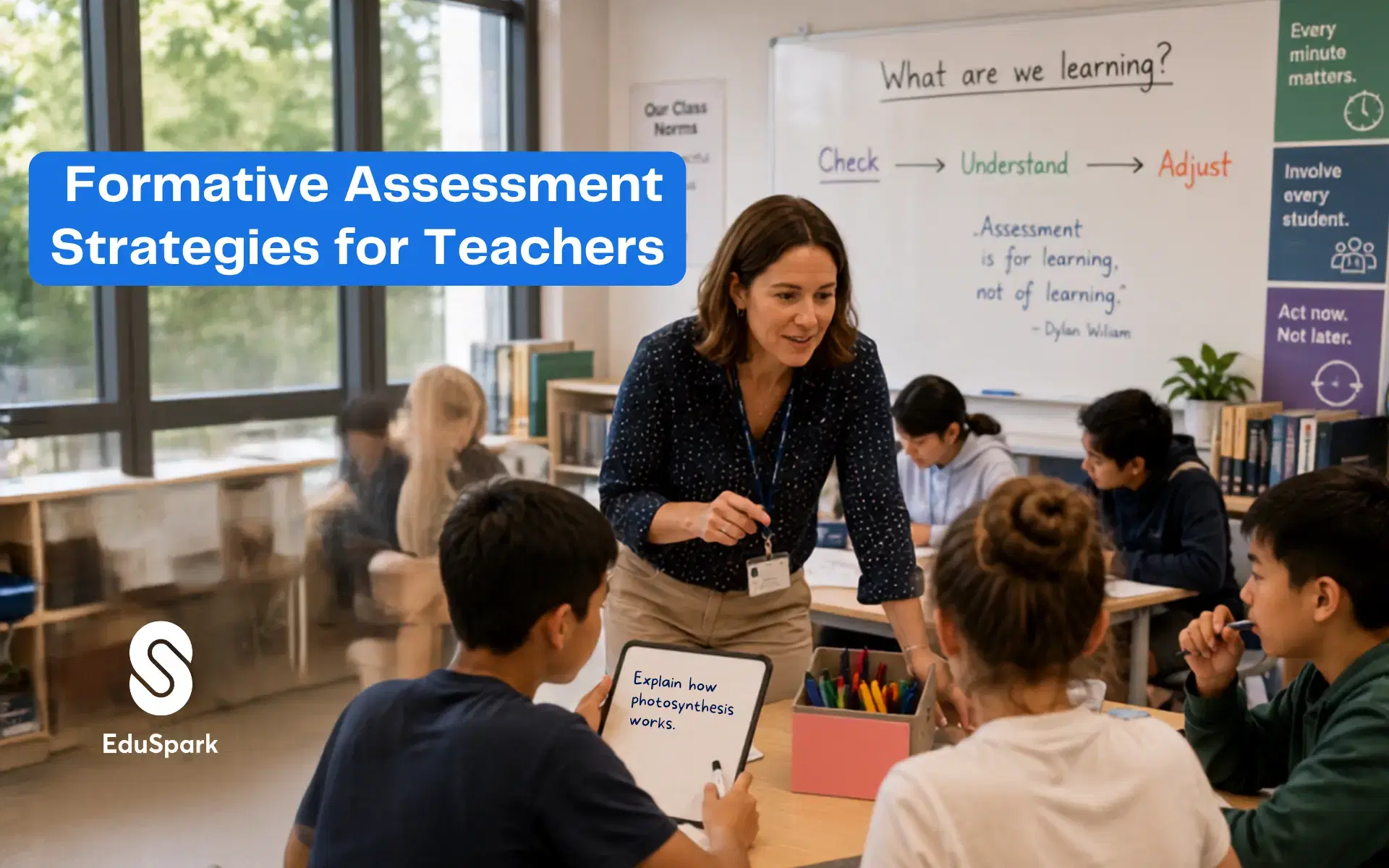
Formative Assessment Strategies Every International School Teacher Should Know
Quick answer
Formative assessment is the practice of checking student understanding during learning, not after it, and using what you find out to adjust teaching immediately. Paul Black and Dylan Wiliam's influential 1998 review reported a range of typical effect sizes of 0.4 to 0.7 standard deviations across the controlled studies they examined, larger than most educational interventions, and found it particularly effective at narrowing the gap between lower and higher achievers. That range was a spread across studies rather than a single pooled average, and a later meta-analysis put the reliable average lower, around 0.2 to 0.25 (Kingston & Nash, 2011). The most actionable principle, from Wiliam's later work, is about timing: check understanding continuously within a lesson, minute by minute, not once every few weeks.
Key facts
- Black and Wiliam reported typical effect sizes of 0.4 to 0.7 SD across the controlled studies they reviewed, larger than most educational interventions, though this was a range across studies, not a single pooled average (Black & Wiliam, 1998).
- A later meta-analysis found the reliable average effect is more modest, around 0.2 to 0.25 SD, and cautioned that the widely-quoted 0.4 to 0.7 range overstates what is actually supported (Kingston & Nash, 2011).
- Formative assessment is particularly effective for students who have not done well previously, narrowing the achievement gap while raising overall achievement (Black & Wiliam, 1998).
- The most actionable principle, from Wiliam's later work, is about timescale: effective formative assessment happens on a scale of minutes, not weeks (Leahy, Lyon, Thompson & Wiliam, 2005).
Formative vs summative, in one line
Summative assessment measures what a student learned at the end. Formative assessment finds out what a student understands while there's still time to act on it. Both matter, but only one of them can change what happens in tomorrow's lesson.
The finding that changes how you'd actually run a lesson
The most consequential idea in this body of work isn't a technique, it's a timescale, a point Wiliam sharpened in his later writing (Leahy, Lyon, Thompson & Wiliam, 2005): high-quality formative assessment happens continuously during a lesson, not once at its end and not once every few weeks in a formal test. That means the practical unit of formative assessment is the exchange, a question, a quick check, a piece of work glanced at mid-task, not the quiz.
It is also genuinely hard to do consistently: many teachers believe they practise formative assessment well while still relying on the same few confident hand-raisers, because doing it properly means constantly checking for understanding and involving every student.
Practical strategies that follow directly from the research
Check understanding constantly, not periodically. Cold-calling, quick all-response checks (mini whiteboards, thumbs, digital polls), and circulating during independent work all serve the same underlying goal: finding out what's actually understood before moving on, not after.
Make the check-in involve everyone, not volunteers. The research specifically flags "involving all students" as part of what makes formative assessment effective. A question answered by the same three confident students tells you almost nothing about the other twenty five.
Act on what you find immediately. Formative assessment that doesn't change the next five minutes of teaching isn't formative, it's just observation. If a quick check reveals half the class hasn't grasped a step, the plan for the rest of the lesson needs to change on the spot.
Prioritise it for students who are behind, not just as a whole-class tool. The achievement-gap-narrowing effect specifically comes from how formative assessment supports students who haven't done well previously, which argues for weighting your attention there rather than assuming a whole-class technique benefits everyone equally.
Where this connects to UDL and inquiry-based teaching
Formative assessment isn't a separate initiative from either UDL or inquiry-based practice, it's the mechanism that makes both of them responsive rather than a one-size-fits-all attempt at differentiation or a guessing game about where students are in an inquiry cycle. See our guides on UDL vs differentiation (https://eduspark.world/blog/udl-vs-differentiation) and inquiry-based learning (https://eduspark.world/blog/inquiry-based-learning-guide) for how the three connect in practice.
Frequently asked questions
Is formative assessment the same as low-stakes quizzing?
Not quite. Quizzing can be one tool, but the research defines formative assessment more broadly as any practice that surfaces understanding during learning and is then used to adjust instruction. A quiz that isn't acted on isn't functioning formatively.
How often should formative assessment happen in a lesson?
The research's own framing is deliberately provocative: on a scale of minutes, not weeks. In practice this means multiple, brief checks-for-understanding within a single lesson, not just a single technique used once.
Does formative assessment work for every subject and age group?
The original Black and Wiliam review synthesised evidence across a wide range of subjects and age groups and found consistent effects, though the specific techniques (a quick maths check versus a discussion-based English check) will naturally look different by subject.
Sources
- Paul Black & Dylan Wiliam, Inside the Black Box: Raising Standards Through Classroom Assessment (1998): kappanonline.org
- Neal Kingston & Brooke Nash, Formative Assessment: A Meta-Analysis and a Call for Research, Educational Measurement: Issues and Practice 30(4) (2011): doi.org/10.1111/j.1745-3992.2011.00220.x
- Siobhan Leahy, Christine Lyon, Marnie Thompson & Dylan Wiliam, Classroom Assessment: Minute by Minute, Day by Day, Educational Leadership 63(3) (2005): ascd.org
Turn formative assessment from a good intention into a habit. Start learning free (https://eduspark.world/courses) or explore the wider professional development guide (https://eduspark.world/blog/professional-development-international-schools).