How Much Should an International School Budget for PD?
How Much Should an International School Budget for PD? (Real Numbers)
Quick answer
Independent School Management's long-standing guidance for independent and international schools recommends around 2% of total budget for faculty professional development (plus 1% for non-teaching staff), though research shows most schools spend far less: 82% spend 1% or below. That's a different benchmark from the US public-district figures often quoted alongside it (a 2015 TNTP study found $18,000 per teacher per year in total development spend at large districts, and PD has held at roughly 3.5% of district budgets for two decades), which describe a different population and shouldn't be read as continuous with the ISM numbers. There's no single global figure for international schools specifically, so use the shape of the spend, not the exact dollar amount, as your guide.
Key facts
- 2% of total budget for faculty PD (+1% for non-teaching staff) is Independent School Management's Success Predictor No. 17 recommendation, for independent and international schools specifically.
- 82% of schools currently spend 1% or less of budget on PD, per the same ISM research. Most schools are underfunding this line, not overfunding it.
- Separately, in the US public sector: a 2015 TNTP study (The Mirage) found large districts spent an average of $18,000 per teacher per year in total development spend, a broad figure including staff time, vendor contracts and extra pay tied to postgraduate credits, not direct training cost alone.
- Also in the US public sector, PD spending has held at roughly 3.5% of district budgets for 20 years (Research Partnership for Professional Learning, Annenberg Institute, Brown University, 2025). This and the TNTP figure describe US public districts, not independent or international schools.
What the research actually says
The clearest data on PD spend comes from US school and district research, since there's no equivalent international-school-wide dataset, but it splits into two populations that shouldn't be blended together.
Among independent and international schools, Independent School Management (ISM), which advises these schools directly, recommends roughly 2% of total budget expenses for faculty professional development, plus a further 1% for professional development of non-teaching staff including trustees, yet ISM's own data shows 82% of responding schools currently spend 1% or less.
Separately, in the US public sector: a 2015 TNTP study of large districts, The Mirage, found an average of $18,000 per teacher per year in total development spend, a figure that reflects staff time, vendor contracts and extra pay tied to postgraduate credits rather than direct training cost alone, and is now a decade old. A 2025 analysis by the Research Partnership for Professional Learning (based at the Annenberg Institute, Brown University) found that PD has consistently made up only around 3.5% of district budgets for the last two decades in that same public-district population. Spending has grown with inflation, not as a share of priority, but none of this transfers directly to an independent or international school's budget.
For international schools, the useful takeaway isn't the dollar figure (currencies, fee structures and cost of living vary too much for that to transfer directly). It's the shape of the spend: PD budgets that lean heavily on flying staff to external training cost dramatically more per hour of learning than budgets built around online and school-based formats, for a comparable (often better) impact on classroom practice.
Why the format mix matters more than the total
Flying one teacher to one regional conference (flights, accommodation, registration and cover for their classes) can easily exceed the cost of a full year of online PD for an entire department. That doesn't mean conferences have no place; networking, exposure to new practice and cross-school connection are real benefits an online course can't replicate. It means they work best as the exception in a budget, reserved for a school's highest-priority area or its most senior staff, rather than as the default spend.
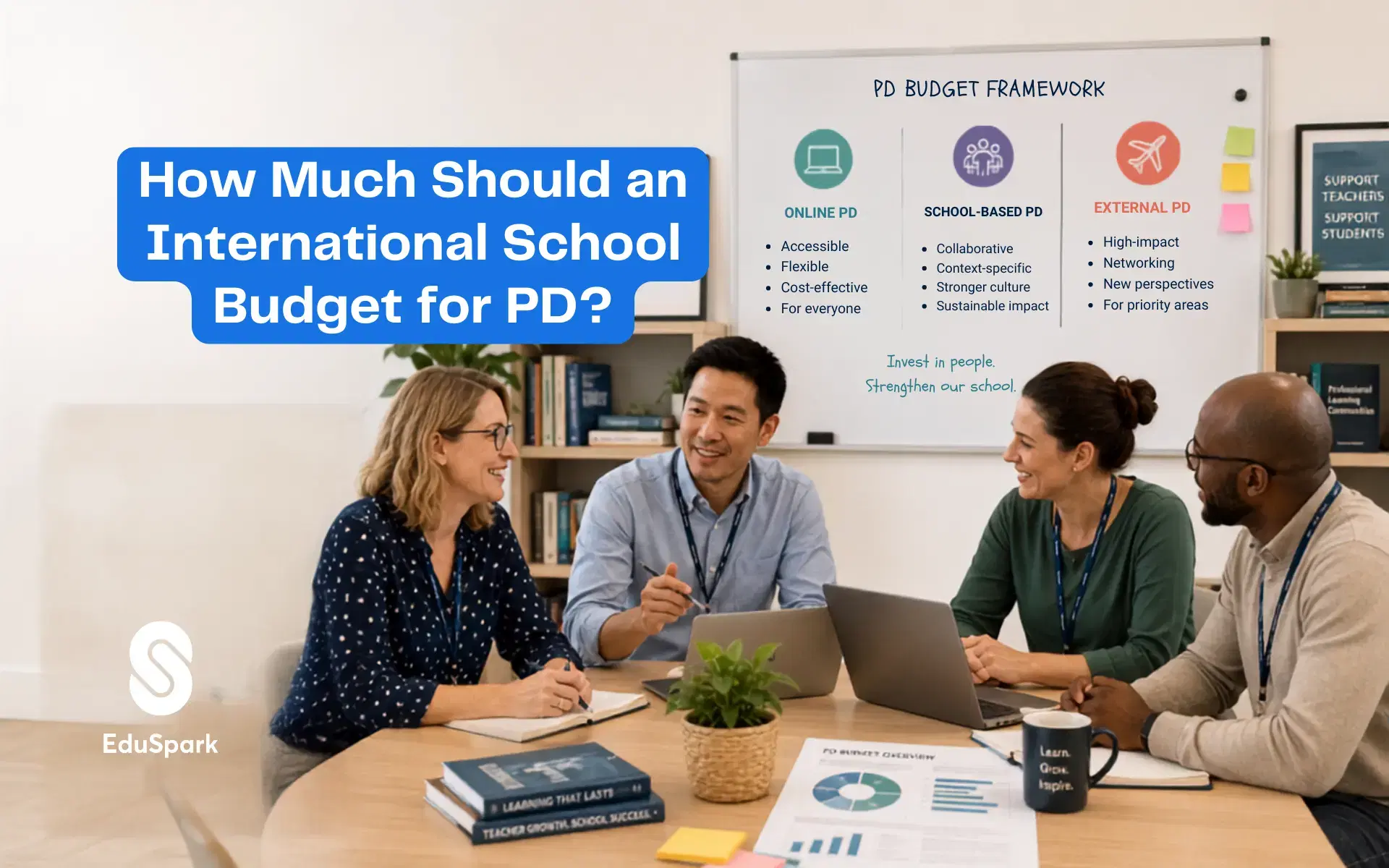
A budget built around three tiers tends to stretch furthest:
1. A spine of self-paced online courses: low per-teacher cost, available to every staff member regardless of role or seniority, and the easiest tier to scale as staff numbers grow.
2. School-based collaborative time: coaching, peer observation, department-led sessions. Low direct cost, but requires protected staff time, which is a real cost even without a line item.
3. Targeted external input: consultants, conferences, official curriculum-body workshops (IB, Cambridge, Pearson Edexcel), reserved for the priorities where outside expertise genuinely changes the trajectory.
A worked example
For illustration only, adjust the numbers to your school's actual staff count and regional costs:
- Online courses (platform), all teaching staff: per-seat licence cost times staff count, typically the lowest cost-per-teacher tier.
- School-based coaching/collaboration, all teaching staff: mostly staff time, plus any coordinator/coaching stipend.
- External workshops/conferences, a small number of targeted staff (coordinators, priority-area leads): flights + accommodation + registration + cover per attendee, often 5-10x the per-teacher cost of the other two tiers combined.
A school that spends most of its external-training budget on a handful of high-priority conference seats, while giving every teacher access to online courses and protected collaboration time, generally reaches more staff per dollar than one that spreads conference spend thinly across many staff.
How to set your number, not just borrow one
Rather than importing a percentage, build the budget from your plan: identify your two or three school-improvement priorities, decide which tier of PD serves each one, and price out that mix. We walk through this process (goals, audit, formats, calendar, evidence) in how to plan a whole-school PD programme: https://eduspark.world/blog/plan-whole-school-professional-development
If you want a single figure to start from: anchor on ISM's 2% of total budget for faculty PD, weigh it toward online and school-based formats, and keep conference spend as the exception rather than the rule. Then adjust up or down from your own priorities and staff tenure. The percentage is a starting point, not a target.
The retention argument for spending more, not less
A PD budget that looks like a cost line is easier to cut than one framed as a retention investment. ISC Research's Teacher Movement Report 2024 found "improved career prospects elsewhere" to be the top reason international teachers give for leaving, and international recruitment agencies typically charge 20-30% of a placement's annual salary in fees alone, before relocation, flights and cover are counted. The US Learning Policy Institute's 2024 calculator estimates $11,860-$24,930 per teacher in total separation, recruiting, hiring and training costs (US public-school data, offered as an order-of-magnitude reference). Set against either figure, a year of meaningful PD is the cheaper option. We go deeper on this trade-off in how PD improves teacher retention in international schools: https://eduspark.world/blog/pd-teacher-retention-international-schools
Frequently asked questions
What percentage of budget should schools spend on professional development?
Independent School Management's guidance is roughly 2% of total budget for faculty PD plus 1% for non-teaching staff, though most schools spend less: 82% spend 1% or below, per ISM's own research. The mix matters more than the total: a blend weighted toward online and school-based learning outperforms a conference-heavy budget of the same size.
How much does professional development cost per teacher?
It varies enormously by format and population. A 2015 TNTP study of large US public districts found average total development spend of $18,000 per teacher per year, though that's a broad, decade-old figure including staff time and postgraduate pay, not a direct-training-cost number, and it's a US public-district figure rather than an independent or international-school one. Online, self-paced courses typically cost a small fraction of that per teacher reached, since there's no travel, cover or venue cost to scale.
Should international schools budget differently than domestic schools?
The proportions above are a reasonable starting point either way, but international schools should weight spend more heavily toward staff-wide online access and structured induction, given the sector's shorter average staff tenure (1-6 years, per ISC Research) compared with most domestic systems.
Sources
- Independent School Management, Success Predictor No. 17: isminc.com
- TNTP, The Mirage: Confronting the Hard Truth About Our Quest for Teacher Development (2015): tntp.org
- Research Partnership for Professional Learning (Annenberg Institute, Brown University), The Cost of Improvement: How Districts Spend on Teacher Professional Learning (2025): rpplpartnership.org
- Learning Policy Institute, 2024 Cost of Teacher Turnover factsheet (US data): learningpolicyinstitute.org
- ISC Research, Teacher Movement Report 2024: iscresearch.com
See exactly what a whole-staff online PD budget looks like with EduSpark's per-seat pricing. Book a demo (https://eduspark.world/book-a-demo) and we'll model it against your actual staff numbers.