How to Plan a Whole-School Professional Development Programme That Teachers Actually Complete
Quick answer
To plan whole-school professional development that teachers actually finish, start from your school improvement goals rather than a course catalogue, audit what staff genuinely need, narrow to a small number of focus areas, build a year-long calendar that mixes formats and protects time to apply what's learned, and decide upfront what evidence of impact you'll collect. Completion depends less on the content and more on relevance, protected time, and teacher voice in the plan.
Key facts
- International schools retain a given teacher for roughly 1-6 years on average (ISC Research, Teacher Movement Report 2024), so a meaningful share of staff is new to the school's PD plan every year.
- CIS accreditation standards require PD to be tied to staff appraisal outcomes, student achievement data and school goals, with evidence produced at review.
- Independent School Management recommends around 2% of total budget for faculty PD, yet most schools spend 1% or less.
Here's how to do that in practice, in six steps.
Step 1: Start from school goals, not a course catalogue
Begin with the two or three things your school is actually trying to improve this year, whether that's writing across the curriculum, assessment for learning, or safeguarding practice. Every PD choice should trace back to one of them. Programmes fall apart when they start from what's available rather than what the school needs, because teachers can tell the difference between learning that matters to their classroom and learning that fills a slot.
Step 2: Audit what staff actually need
Goals set the direction; a needs audit sets the detail. A short survey, a look at appraisal themes, and a conversation with middle leaders will usually surface where the real gaps are, and they're rarely uniform across a staff. A teacher in their first international posting needs something different from a head of department of fifteen years. Planning as though everyone needs the same thing is the fastest route to disengagement.
Step 3: Choose formats that fit how teachers actually learn
Match the format to the goal, not to habit. A one-off workshop can introduce an idea but rarely changes practice on its own. Self-paced online courses work for building baseline knowledge across a whole staff at different times. Coaching and peer observation are better suited to embedding a technique. Most strong plans blend all three, with expensive one-off events used to begin learning rather than to be the whole of it.
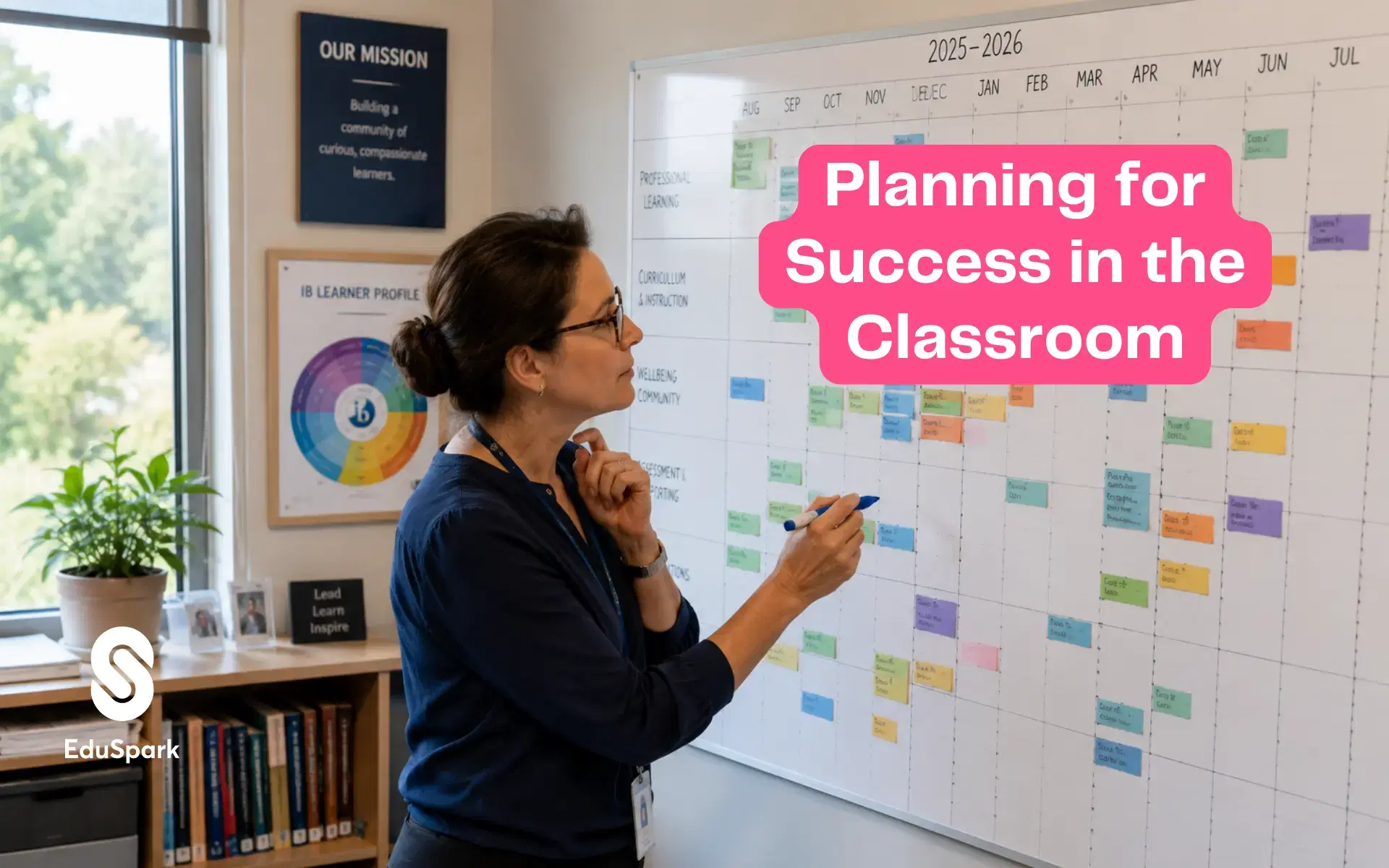
Step 4: Put it on the calendar, with time to apply it
A plan that isn't timetabled isn't a plan, it's a wish. Protect regular time and treat it as you would a lesson, not as the first thing cancelled in a busy week. Just as importantly, build in time to apply the learning, because professional learning without application is simply attendance. A session followed by three weeks of nothing produces a certificate and no change.
Step 5: Define evidence of impact before you start
Decide at the planning stage what you'll look for and how you'll capture it, whether that's a change in a specific classroom practice, movement in student work, or teacher-reported confidence. Accreditors such as CIS increasingly want PD tied to appraisal and student outcomes, with evidence produced rather than described, and it is far easier to collect that as you go than to reconstruct it before a visit.
Step 6: Review termly and prune ruthlessly
A year-long plan is a hypothesis, not a contract. Review it each term, keep what's working, and drop what isn't, even if it looked good on paper in August. The temptation is always to add more. The stronger discipline is to protect a small number of priorities and see them through, because a staff pulled in six directions completes none of them well.
Why teachers don't complete PD, and what changes it
Most whole-school PD isn't abandoned because teachers don't care. It's abandoned because it's generic, untimetabled, or disconnected from what a teacher is actually trying to do in their room. Fix those three and completion tends to look after itself.
The pattern shows up clearly at scale. In one group of eight international schools across four countries that EduSpark worked with, the campuses with the highest completion weren't the largest or best resourced. They were the ones where teachers had a genuine voice in what they learned, where it was built into the weekly routine, and where it connected directly to their classrooms. Where schools got that combination right, completion reached as high as 75%. Teachers who finished even a couple of courses became roughly three times more likely to start running informal sessions for colleagues, which is how a plan stops being something delivered from above and starts spreading on its own. The lesson for planning is simple: relevance, protected time, and teacher voice do more for completion than any amount of content.
A note on retention
Planning PD well pays back twice, because development is one of the reasons teachers stay. ISC Research's Teacher Movement Report 2024 found "improved career prospects elsewhere" to be the top reason international teachers cite for leaving. A school that visibly invests in growth, rather than treating PD as a compliance exercise, is answering the exact need that most often pulls good teachers out of the door.
FAQ
Why don't teachers complete professional development?
Usually because it's generic, not timetabled, or disconnected from their actual classroom. Completion improves most when PD is relevant to a teacher's real work, given protected time, and shaped with teacher input rather than handed down.
How long should a whole-school PD plan run?
A full school year is the common unit, reviewed each term. Anything shorter struggles to show impact; anything locked for longer tends to drift from what the school actually needs by the time it's halfway through.
How do you measure the impact of professional development?
Decide before you start. Define the change you expect to see, in classroom practice, student work, or teacher confidence, and capture evidence as you go. Accreditation bodies such as CIS expect PD tied to appraisal and student outcomes, with evidence produced, not just described.
Sources
- ISC Research, Teacher Movement Report 2024: iscresearch.com
- Independent School Management, Success Predictor No. 17: isminc.com
- Council of International Schools, International Accreditation Standards and Indicators: cois.org
EduSpark gives international schools a complete professional learning platform: expert-built courses, progress analytics, and verifiable portfolios your accreditation visitors will love. See it with your own staff data: https://eduspark.world/book-a-demo