Inquiry-Based Learning: A Starter Guide for International School Teachers
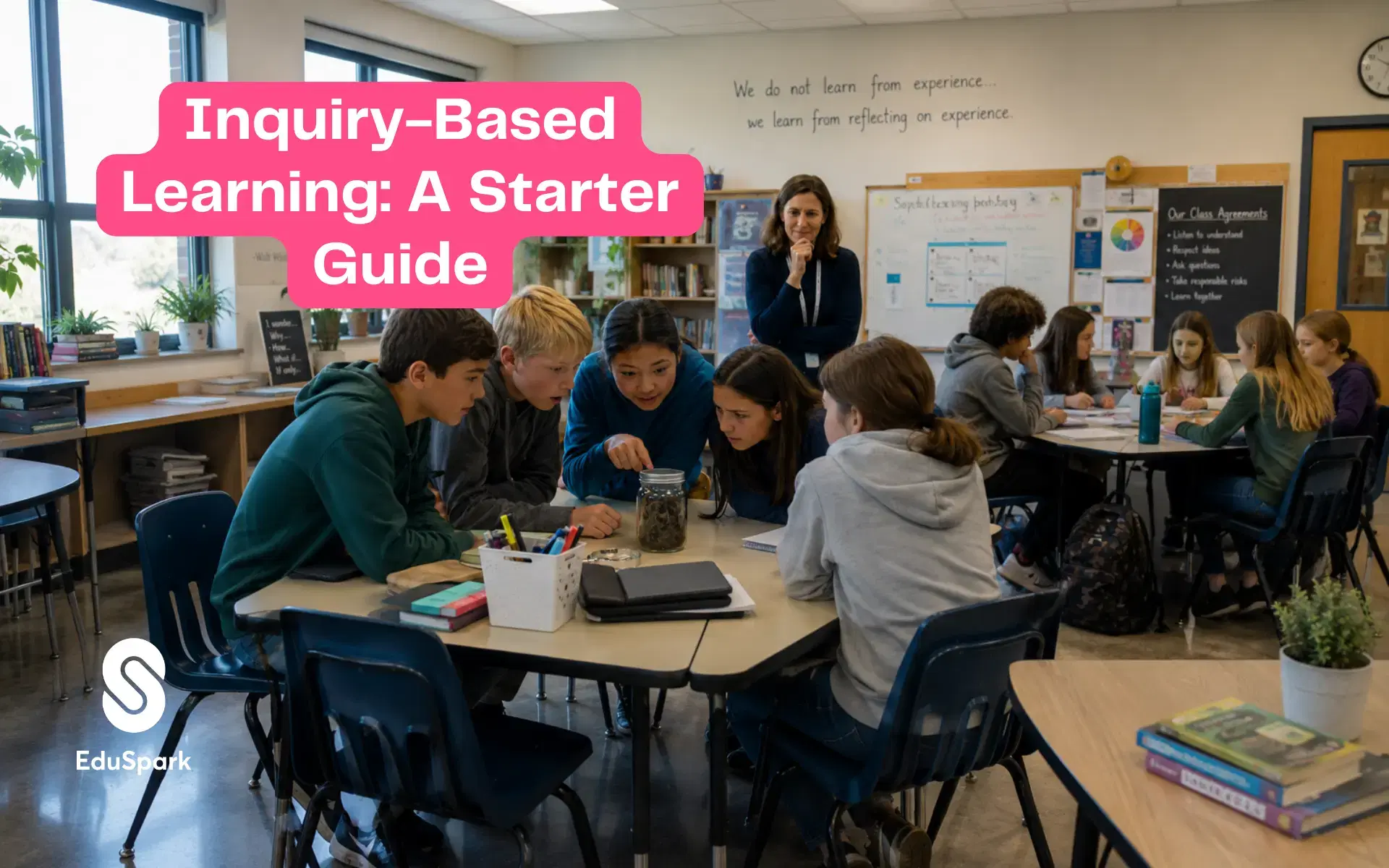
Inquiry-Based Learning: A Starter Guide for International School Teachers
Quick Answer:
Inquiry-based learning shifts the teacher's role from delivering content to facilitating student-driven investigation. It sits on a spectrum from confirmation inquiry (most teacher-directed) to open inquiry (most student-directed), a framework first published by Banchi and Bell in 2008.
Key facts
Inquiry-based learning is commonly described across four types: confirmation, structured, guided, and open inquiry, first laid out by Banchi and Bell in The Many Levels of Inquiry (2008).
The core shift is from teacher-as-content-deliverer to teacher-as-facilitator, with assessment focused on process skills and critical thinking, not just content recall.
It's a foundational pedagogy in IB Primary Years Programme classrooms specifically, which the IB describes as transdisciplinary and inquiry-based by design, though the practices apply well beyond IB schools.
The four types of inquiry, briefly
Confirmation inquiry: students confirm a principle already taught, through a guided investigation with a known outcome. The most structured, teacher-directed end of the spectrum.
Structured inquiry: the teacher provides the question and procedure; students work out the result themselves.
Guided inquiry: the teacher provides only the question; students design their own procedure and investigation.
Open inquiry: students generate their own questions, design, and investigation. The most student-directed end of the spectrum.
Most classrooms move across this spectrum depending on the topic, the students' experience with inquiry, and the time available. It isn't a ladder you climb once and stay at the top of.
What actually changes in the classroom
Three shifts show up consistently in classrooms that run on inquiry rather than direct instruction alone:
Questions come from students, not just the teacher. A visible space (a wall, a shared doc, a "wonder wall") where students post questions as they arise keeps curiosity part of the daily routine rather than confined to a single "inquiry lesson."
The teacher's job moves from answering to provoking. Presenting an object, a phenomenon, or a puzzling scenario without an immediate explanation, and letting the resulting questions drive the next steps, is a deliberate, practised skill, not simply "less teaching."
Assessment looks at the thinking, not just the output. Portfolios, presentations and performance-based tasks that capture the reasoning process matter as much as the final answer, since the whole point of inquiry is the thinking students do to get there.
Building a culture, not a unit
A single inquiry lesson doesn't build an inquiry culture. That takes sustained practice, ideally supported by planning tools and coaching rather than reinvented from scratch each unit. Three EduSpark courses go deeper on different parts of this:
For the underlying practices, The Art of Inquiry (https://eduspark.world/courses/the-art-of-inquiry) (Spark+, $75, 7 modules, ~2 hours) is taught directly by Kath Murdoch and works through the first five teacher practices from her book of the same name: noticing, curiosity, building learning assets, release, and questioning.
For a practical planning template, Planning for Inquiry (Six Steps w/ Template) (https://eduspark.world/courses/planning-for-inquiry-six-steps-w-template) (Pro, 10 modules, ~2 hours) is led by Kimberly L. Mitchell, founder of Inquiry Partners and author of Experience Inquiry, and includes a ready-to-use lesson plan template for turning any unit into an inquiry-based one.
For coordinators building this across a programme, The Conceptual Inquiry Process (https://eduspark.world/courses/the-conceptual-inquiry-process) (Pro) with Tania Lattanzio covers refining how inquiry runs at the programme level, not just the classroom level.
To start free, A Conversation With Kath Murdoch and Five Key Inquiry Strategies are both free and give a fast, practical entry point before committing to a longer course.
Frequently asked questions
Is inquiry-based learning the same as IB's approach to teaching?
Inquiry is a foundational pedagogy in IB PYP classrooms specifically, but the practices, student-generated questions, teacher-as-facilitator, process-focused assessment, apply in any classroom, IB or not.
Do I have to choose one type of inquiry and stick with it?
No. Most effective practice moves across confirmation, structured, guided and open inquiry depending on the topic and how much experience students already have with inquiry-based work.
What's the fastest way to start if I've never taught this way before?
Start with a single provocation: an object, image or question with no immediate explanation, and a dedicated space for student questions. Build up to guided and open inquiry as students get more practised at generating their own questions.
Sources
Heather Banchi & Randy Bell, The Many Levels of Inquiry, Science and Children, 46 (2008), pp. 26-29: nsta.org
International Baccalaureate, Primary Years Programme, Learning and Teaching: ibo.org
EduSpark course: The Art of Inquiry (Kath Murdoch): eduspark.world/courses/the-art-of-inquiry
Kath Murdoch, The Power of Inquiry: Teaching and Learning with Curiosity, Creativity and Purpose in the Contemporary Classroom (Seastar Education, 2015)
EduSpark course: Planning for Inquiry, Six Steps w/ Template (Kimberly L. Mitchell, Inquiry Partners): eduspark.world/courses/planning-for-inquiry-six-steps-w-template
EduSpark course: The Conceptual Inquiry Process (Tania Lattanzio): eduspark.world/courses/the-conceptual-inquiry-process
Ready to build a real culture of inquiry, not just a unit? Start with Kath Murdoch's free course: https://eduspark.world/courses/a-conversation-with-kath-murdoch