Online vs In-Person Teacher PD: Cost and Impact Compared for International Schools
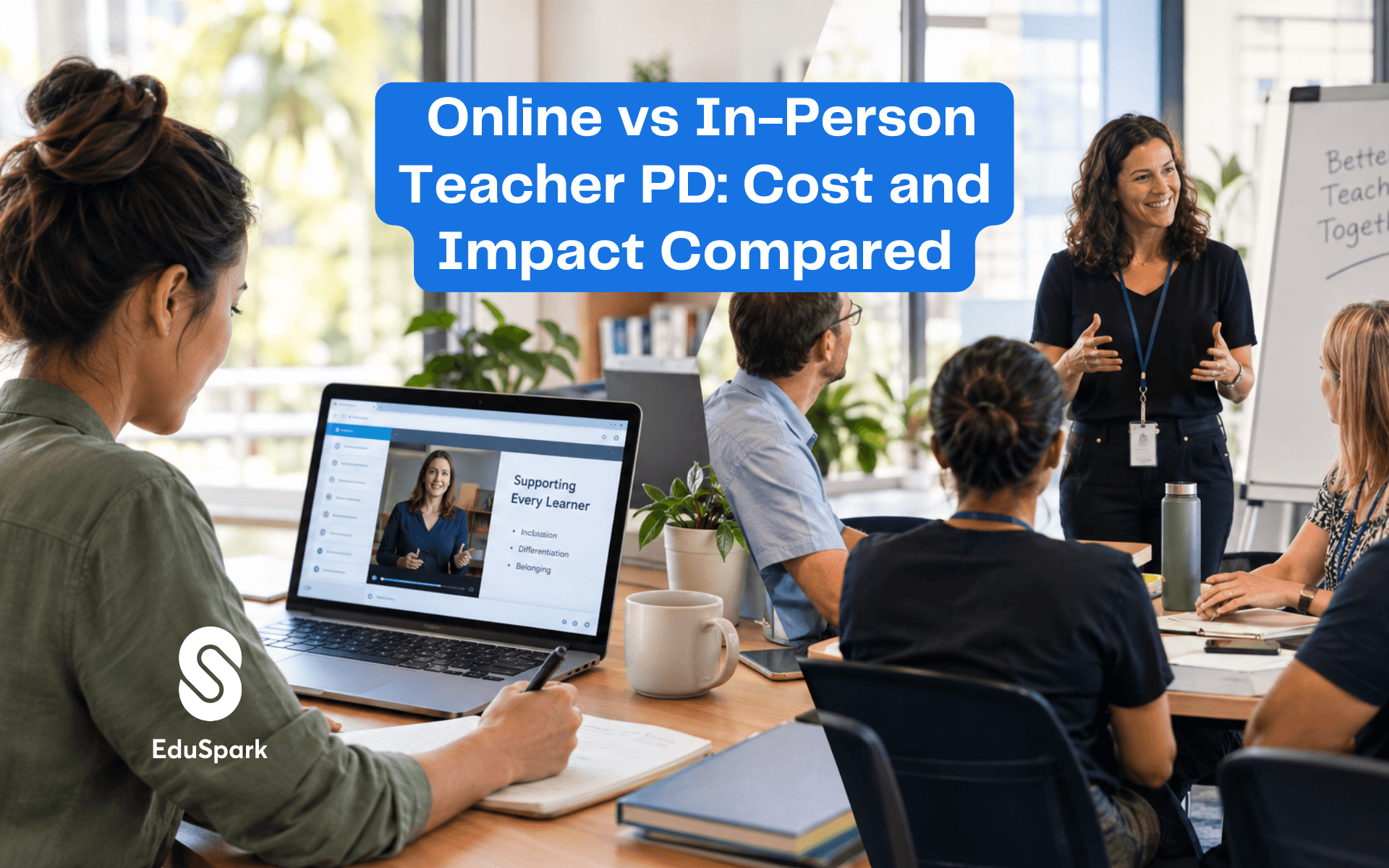
Online vs In-Person Teacher PD: Cost and Impact Compared for International Schools
Quick answer
Neither online nor in-person professional development is inherently more effective. The evidence is clear that what makes PD work is its underlying mechanisms, goal-setting, good technique, feedback and embedding practice, rather than the format it's delivered in. Online and self-paced PD lowers the biggest barriers teachers report (scheduling and cost) and scales cheaply across a whole staff; in-person adds presence and connection but carries travel and cover costs. The strongest programmes blend them, and design matters far more than medium.
Key facts
- What determines whether PD works is its underlying mechanisms, not its form of delivery: the Education Endowment Foundation advises schools to focus on mechanisms rather than the type of PD (EEF, Effective Professional Development, 2021).
- Well-designed online and blended PD can match or exceed in-person; a US Department of Education meta-analysis found blended learning tended to outperform both purely online and purely face-to-face, while cautioning that the advantage comes from design and added learning time, not the medium itself (Means et al., 2010).
- The barriers teachers most often cite to doing PD are scheduling conflicts (54%) and cost (around 45%), exactly the barriers online and self-paced PD is positioned to lower (OECD, TALIS 2018).
Is online or in-person PD more effective?
This is the question everyone asks, and it's the wrong one. When the Education Endowment Foundation reviewed the evidence on effective professional development, its central conclusion was that effectiveness is determined by a set of underlying mechanisms, building knowledge, motivating teachers, developing technique, and embedding practice, not by the form the PD takes. A workshop with those mechanisms beats an online course without them, and vice versa. The format is not the variable that matters most; the design is. We unpack those mechanisms in our guide to what actually counts as effective CPD: https://eduspark.world/blog/cpd-international-school-teachers
The evidence on delivery mode points the same way. A US Department of Education meta-analysis, focused on student learning rather than teacher PD specifically, found online learners performed modestly better than face-to-face on average, with blended approaches doing best of all. The authors stressed the blended advantage came from better design and more learning time, not the technology. The principle carries straight over to PD: a well-designed online programme can match an in-person one, and a badly designed one can't.
What does each format actually cost?
Here the two formats genuinely differ, and it's where the budget conversation lives. In-person PD carries travel, accommodation, registration and cover costs that online and self-paced PD simply doesn't. Flying one teacher to one regional conference can exceed a year of online courses for an entire department.
Online / self-paced PD: the cost driver is a per-seat licence that scales cheaply across staff; it reaches the whole staff on any schedule; its main strength is lowering scheduling and cost barriers with consistent content; its main weakness is completion without accountability.
In-person workshop or conference: the cost driver is registration plus flights, accommodation and cover per attendee; it reaches only a few attendees at a time; its main strength is presence, networking and hard-to-replicate energy; its main weakness is cost per teacher and often little follow-through.
A useful benchmark for how much schools spend on PD overall: TNTP's 2015 study of large US public districts estimated nearly $18,000 per teacher per year in total development spend, though that's a broad figure covering staff time and much more, not the cost of in-person events specifically. We go deeper on the numbers in our international school PD budget guide: https://eduspark.world/blog/international-school-pd-budget
What does online PD do better?
It removes the barriers that stop PD happening at all. The two biggest obstacles teachers report, per OECD's TALIS survey, are that PD conflicts with their work schedule (54%) and that it's too expensive (around 45%). Self-paced online PD is aimed squarely at both: teachers do it when it fits, and the per-teacher cost is a fraction of flying anyone anywhere. It also reaches everyone, so a whole staff gets the same content rather than two people bringing back a conference they can't quite explain.
What does in-person PD do better?
Presence. A skilled facilitator in a room can read the group, spark a debate, and generate an energy that's genuinely hard to reproduce on a screen. In-person events are also where cross-school networking happens, and some official training, such as certain IB Category workshops (https://eduspark.world/blog/ib-teacher-professional-development-online), is only delivered in person or as scheduled live sessions. In-person has a real place. It just works best as the exception in a budget, reserved for the highest-priority moments, rather than the default.
Where does online PD fall down, honestly?
One weakness worth naming plainly, because pretending otherwise helps no one: self-paced online PD has a completion problem. Left to pure self-direction, without accountability or support, completion rates can be low, the same pattern seen across self-paced online courses generally. Online PD is not a magic efficiency button, and any claim that it "saves X hours" or "boosts completion by Y%" should be treated with suspicion. What closes the gap is design: protected time, a clear reason the learning matters, follow-up, and evidence of application. Online PD earns its advantages only when it's built to be finished and applied, not just assigned.
So what should a school actually do?
Stop choosing, and design a blend around the mechanisms that matter. A strong programme usually looks like this: a spine of self-paced online courses that reaches every teacher cheaply and consistently, protected collaborative time to apply and embed what's learned (this is the mechanism most formats skip), and targeted in-person input reserved for a school's single highest priority or most senior staff. Build it around goal-setting, feedback and embedding practice, and it almost doesn't matter which slice is online and which is in the room. Our six-step guide to planning whole-school PD (https://eduspark.world/blog/plan-whole-school-professional-development) walks through building exactly that mix.
Frequently asked questions
Is online teacher PD as good as in-person?
It can be. The evidence says effectiveness comes from a PD programme's underlying mechanisms, not its delivery mode, and well-designed online or blended PD can match or exceed in-person. A poorly designed version of either underperforms.
Is online PD cheaper than in-person?
Almost always, per teacher reached. Online and self-paced PD avoids the travel, accommodation, registration and cover costs of in-person events, and scales across a whole staff for a per-seat cost. See our PD budget guide: https://eduspark.world/blog/international-school-pd-budget
Should we do online or in-person PD?
Both, deliberately blended. Use a self-paced online spine for whole-staff, ongoing learning, protected collaboration time to embed it, and reserve in-person events for your highest-priority area. Design for the mechanisms of effective PD rather than picking a format.
Sources
- Education Endowment Foundation, Effective Professional Development guidance report (2021): educationendowmentfoundation.org.uk
- U.S. Department of Education, Evaluation of Evidence-Based Practices in Online Learning: A Meta-Analysis (Means et al., 2010): sri.com
- OECD, TALIS 2018 Results (Volume II) (barriers to PD participation): oecd.org
- TNTP, The Mirage (2015) (total district PD spend benchmark): tntp.org
Design the PD first, then decide the format. EduSpark gives international schools a self-paced online spine of expert-led courses (https://eduspark.world/courses) that reaches every teacher, with the tracking and evidence to see whether it's landing, so your in-person budget can go where it matters most. Book a demo (https://eduspark.world/book-a-demo) to model the blend against your staff and budget, or start with our whole-school PD planning guide (https://eduspark.world/blog/plan-whole-school-professional-development).