Professional Development in International Schools: The Complete Guide
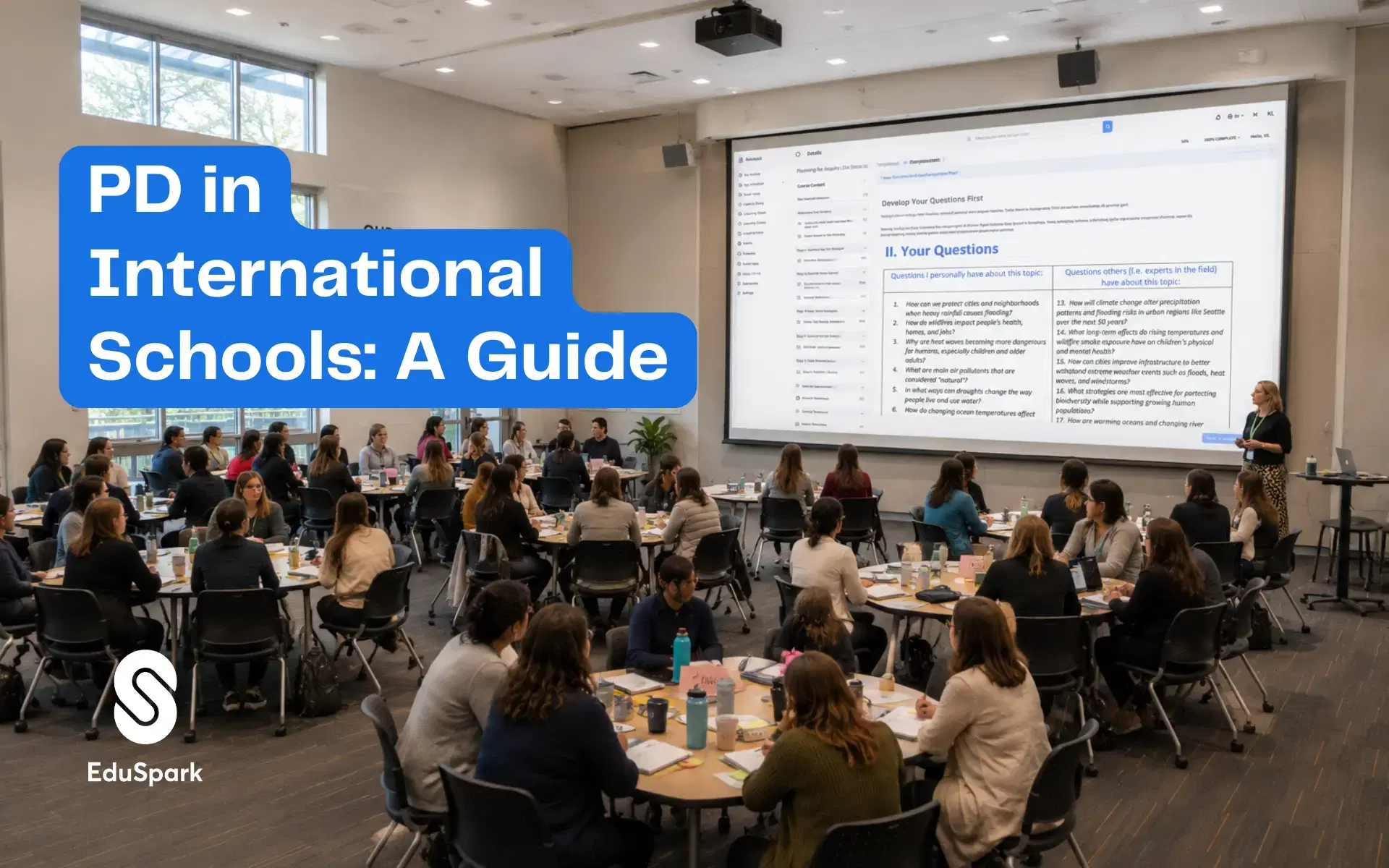
Professional Development in International Schools: The Complete Guide
Quick answer
Professional development (PD) in international schools is the ongoing training that keeps teachers, coordinators and leaders effective in a context with no single regulator, high annual staff turnover, and no national training pipeline to rely on. Independent School Management's benchmark for independent and international schools recommends budgeting around 2% of total spend for faculty PD, though most schools currently spend closer to 1%.
Key facts
- International schools retain a given teacher for roughly 1-6 years on average, per ISC Research's Teacher Movement Report 2024.
- Among independent and international schools, ISM recommends 2% of total budget for faculty PD, yet 82% of schools currently spend 1% or less. This is a different population from the US public-district figures below.
- Separately, in the US public sector, a 2015 TNTP study (The Mirage) found average total PD spend of $18,000 per teacher per year, a broad definition including staff time, vendor contracts and postgraduate pay, not direct training cost alone. It's a decade-old, large-district figure that doesn't translate directly to independent or international schools.
- US public-district PD spending overall has held at roughly 3.5% of district budgets for two decades (Research Partnership for Professional Learning, Annenberg Institute, 2025), again distinct from the ISM benchmark.
Why PD works differently in international schools
High staff turnover, no single regulator, and global recruitment with local safeguarding risk all shape how PD has to be planned in this sector. Most international schools can only expect to retain a given teacher for one to six years.
What counts as professional development
Self-paced online courses, curriculum-specific training (IB, Cambridge, Pearson Edexcel), whole-school and collaborative PD, safeguarding and wellbeing training, leadership development, and external conferences used as the exception rather than the spine.
What accreditation bodies expect
CIS requires professional development tied to staff appraisal outcomes, student achievement data, and school goals, with evidence submitted at accreditation visits.
What it costs
There's no single global benchmark, and the two reference points people usually reach for describe different populations, so they need to be read separately. In the US public sector, the 2015 TNTP study found $18,000 per teacher per year in total development spend, and PD makes up only about 3.5% of district budgets. Among independent and international schools specifically, ISM recommends roughly 2% of total budget, yet 82% of schools spend 1% or less.
PD and retention
ISC Research's Teacher Movement Report 2024 found "improved career prospects elsewhere" to be the primary reason international teachers cite for leaving. The Learning Policy Institute's 2024 calculator estimates $11,860-$24,930 per teacher in US public-school separation and hiring costs, and international recruitment agencies typically charge 20-30% of a placement's annual salary in fees.
FAQ
What is professional development in an international school context?
The structured and self-directed learning that keeps teaching staff, coordinators and leaders effective.
How much PD should a teacher do each year?
There's no universal figure. Evidence of sustained, applied learning matters more than hours.
Who sets PD requirements for international schools?
No single global body does. Requirements come from each school’s own policy, its accreditation body (such as CIS, WASC or MSA), and, for IB programmes, the IB’s own workshop categories on top of that. This is why PD in international schools has to be built and evidenced by the school itself rather than inherited from a national system.
Is free CPD as good as paid professional development?
Free CPD is genuinely useful for topping up specific skills or refreshing knowledge, and plenty of high-quality free courses exist. The difference at whole-school level is tracking and evidence: paid platforms are usually what let a school run PD systematically and produce the per-teacher records accreditation bodies expect. For an individual teacher, free is often enough; for a school proving systematic development, it rarely is on its own.
Sources
- ISC Research, Teacher Movement Report 2024: iscresearch.com
- TNTP, The Mirage: Confronting the Hard Truth About Our Quest for Teacher Development (2015): tntp.org
- Research Partnership for Professional Learning, Annenberg Institute at Brown University: edweek.org
- Independent School Management, Success Predictor No. 17: isminc.com
- Learning Policy Institute, 2024 Cost of Teacher Turnover: learningpolicyinstitute.org
- Council of International Schools: cois.org
Ready to see this in practice? Teachers can start learning free. School leaders can book a demo: https://eduspark.world/book-a-demo