Social-Emotional Learning: A Practical Guide for International School Staff
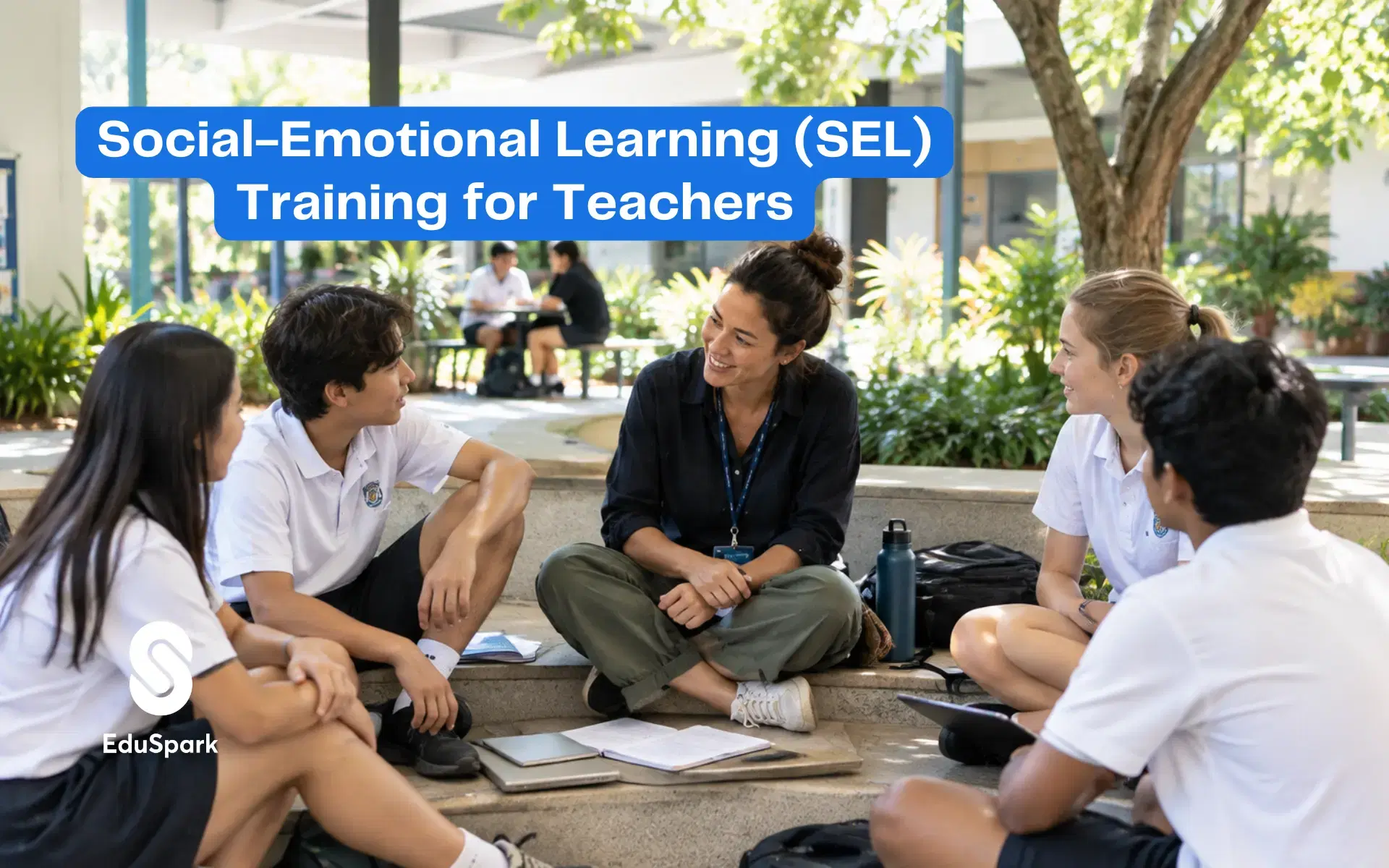
Social-Emotional Learning: A Practical Guide for International School Staff
Quick answer
Social-emotional learning (SEL) is the process through which students and adults build the knowledge, skills, and attitudes needed to manage emotions, set and reach goals, feel empathy, build relationships, and make responsible decisions. CASEL, the field's leading research and policy organisation, organises this into five core competencies: self-awareness, self-management, social awareness, relationship skills, and responsible decision-making. It is not just a feel-good add-on: a landmark meta-analysis of 213 school programmes found students in SEL programmes gained an average of 11 percentile points in academic achievement (Durlak et al., 2011). For international school teachers, the practical challenge is less "what is SEL" and more building it into everyday teaching rather than treating it as a separate weekly lesson.
Key facts
- CASEL defines SEL as the process by which "all young people and adults acquire and apply the knowledge, skills, and attitudes to develop healthy identities, manage emotions and achieve personal and collective goals, feel and show empathy for others, establish and maintain supportive relationships, and make responsible and caring decisions" (CASEL, SEL Framework).
- CASEL's framework identifies five core competencies: self-awareness, self-management, social awareness, relationship skills, and responsible decision-making.
- CASEL's model is explicitly systemic: it coordinates practice across four settings (classrooms, schools, families and caregivers, and communities), not just the classroom in isolation.
- SEL has a measurable academic payoff, not only a pastoral one: a meta-analysis of 213 school-based programmes (270,034 students) found an 11-percentile-point gain in academic achievement for students in SEL programmes versus controls (Durlak et al., Child Development, 2011); a 2023 meta-analysis of 252 interventions across 53 countries reached consistent conclusions (Cipriano et al., Child Development, 2023).
What SEL actually is, beyond the acronym
SEL gets treated in a lot of schools as a discrete curriculum slot: a weekly circle-time lesson, a poster on the wall, a box ticked. CASEL's own framework pushes against that. The five competencies (recognising and understanding your own emotions and their influence on behaviour; managing emotions, thoughts and behaviours effectively; understanding and empathising with people from different backgrounds; building and maintaining healthy relationships; and making thoughtful, ethical decisions) are meant to run through how a school operates day to day, not sit in a single timetabled slot.
In practice, embedding looks small and specific. A literature teacher pausing to name what a character is feeling and why. A maths teacher framing a wrong answer as useful information rather than failure, which is self-management modelled in real time. A form tutor gives a newly arrived student a defined role in a group task, so relationship-building isn't left to chance. None of these is a separate lesson. Each is SEL running through ordinary teaching, which is exactly the point.
Why this matters more, not less, in an international school
International classrooms bring together students from multiple cultural backgrounds, home languages, and prior schooling systems, often with high mobility as families relocate. The "social awareness" and "relationship skills" competencies in particular carry extra weight in this context: understanding and empathising with people from different backgrounds is a live, daily skill in an international classroom, not an abstract value statement. A school that treats SEL as a bolt-on programme is likely to miss the specific relational work its own student population actually needs.
What SEL training for staff should cover
Effective SEL training for teachers (not students) typically covers three things:
Understanding the framework itself. Teachers need to recognise the five competencies well enough to spot where their existing practice already supports them, and where it doesn't, rather than learning SEL as an entirely separate add-on subject. A short foundational course on the framework, the kind of self-paced module we build into EduSpark, is usually enough to establish that shared language; the harder, more valuable work happens after it, in everyday practice.
Embedding SEL into everyday teaching, not just a dedicated lesson. CASEL's systemic model treats classroom practice, school culture, and family/community connection as three coordinated settings. Training that only addresses the classroom lesson misses two of the three.
Modelling the competencies as adults. Staff wellbeing and staff relationships are part of the same system CASEL describes. A staff room where self-awareness, social awareness, and relationship skills are visibly modelled by adults reinforces what's being taught to students far more than a curriculum resource can on its own (see our teacher wellbeing guide: https://eduspark.world/blog/teacher-wellbeing-training-international-schools).
Frequently asked questions
Is SEL the same as mental health support?
Related but distinct. SEL is a skills framework (recognising emotions, building relationships, making decisions) that applies to everyone, not a clinical intervention. It can support wellbeing, but it isn't a substitute for mental health services when a student or staff member needs them.
Who created the CASEL framework, and is it internationally recognised?
CASEL (the Collaborative for Academic, Social, and Emotional Learning) is a US-founded non-profit whose framework has become the most widely referenced SEL model globally, including across many international schools, though schools should check how it maps to their specific curriculum framework (IB, national, or otherwise) rather than assuming a one-to-one fit.
Does SEL training need to be a separate course, or can it be embedded in general PD?
Both have a place. A foundational course on the framework itself is useful once, but the deeper work is embedding SEL-aware practice into subject teaching, pastoral care, and staff culture on an ongoing basis, which functions more like coaching and reflection than a single training event (see our instructional coaching guide: https://eduspark.world/blog/instructional-coaching-mentoring-teachers).
Sources
- CASEL, Fundamentals of SEL / SEL Framework: casel.org/fundamentals-of-sel
- Joseph A. Durlak et al., The Impact of Enhancing Students' Social and Emotional Learning: A Meta-Analysis of School-Based Universal Interventions, Child Development 82(1) (2011): doi.org/10.1111/j.1467-8624.2010.01564.x
- Christina Cipriano et al., The State of Evidence for Social and Emotional Learning: A Contemporary Meta-Analysis of Universal School-Based SEL Interventions, Child Development 94(5) (2023): doi.org/10.1111/cdev.13968
Build SEL into everyday practice, not just a weekly slot. See EduSpark's SEL courses (https://eduspark.world/courses) or start learning free (https://eduspark.world/courses).