The Future of Teacher Professional Learning: Building Schools Where Teachers Never Stop Growing
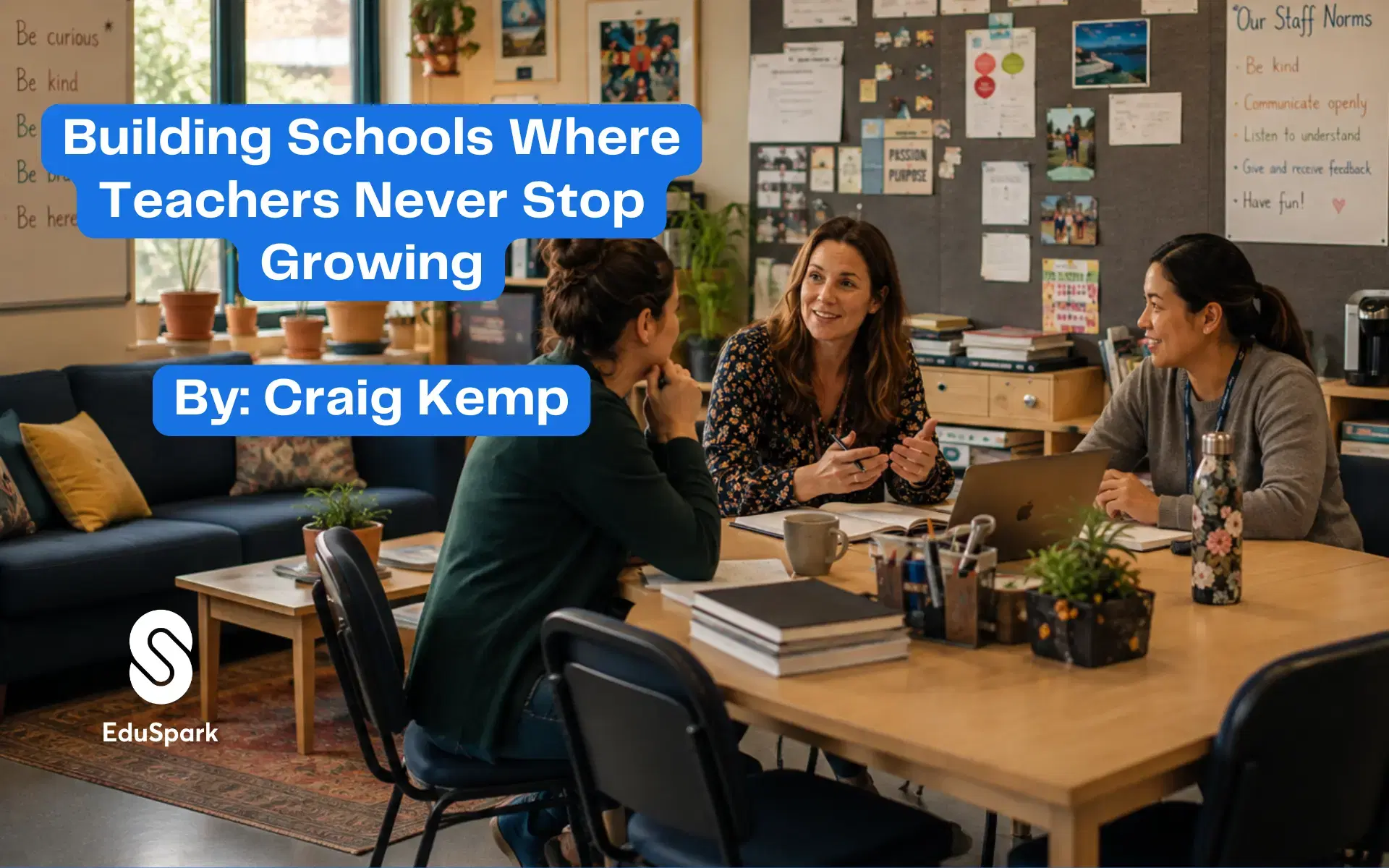
The Future of Teacher Professional Learning: Building Schools Where Teachers Never Stop Growing
There was a version of me, not that long ago, who believed a good conference could change a school.
I was a Tech Director then. Every year I approved the professional development budget for my team, and every year I felt good about it. We sent our coaches to the best events in the region. They came back energised, full of ideas, buzzing with the kind of enthusiasm that makes a staffroom feel alive again. For a week, sometimes two, the corridors felt different.
Then a Monday would arrive one too many times. The photocopier would jam. A parent would email. A class would need covering. And the ideas would quietly fold themselves back into the drawer they came from. By the next school holidays, most of what we had paid for had evaporated. The certificates went into the file. The practice stayed the same.
It took me longer than I would like to admit to understand what was actually happening. We did not have a professional development problem. We had a design problem.
The most expensive habit in education
Professional development is one of the largest discretionary lines in almost any school budget, and one of the least examined. We plan lessons meticulously. We assess learning constantly. We agonise over whether a child has truly understood a concept or simply performed it for a test. Then we turn to the adults in the building and hand them a day out, a lanyard, a lunch, and a hope that something will stick.
Most of it does not stick. Not because teachers are not capable, and not because the speakers are not good. It does not stick because a single event, however brilliant, is asked to do a job it was never designed to do. We expect one day to change what happens on the other one hundred and eighty.
If a child sat through a single inspiring lesson on fractions and never revisited the idea, never applied it, never received feedback on their attempts, we would not be surprised when they could not do fractions in June. We would call that bad teaching. Yet we accept exactly this model for the people we trust to teach.
This is the uncomfortable truth I keep returning to. Schools do not need more professional development. They need better professional learning. The two are not the same thing, and the gap between them is where most school improvement quietly dies.
Conferences are not the enemy
I want to be careful here, because it would be easy to read this as an argument against conferences. It is not.
I speak at conferences around the world. I have watched a single keynote shift how a room of leaders thinks about their schools. I have seen a workshop plant an idea that a teacher carries for a decade. Events matter. Inspiration matters. The problem is not the conference. The problem is where we place it.
We treat the conference as the destination. It should be the doorway.
A good event should begin professional learning, not conclude it. The moment a teacher walks out of a session full of energy is the moment the real work should start, not the moment it finishes. What happens in the three weeks after the conference matters far more than what happened in the room. And in most schools, nothing happens in those three weeks at all, because no one designed for them.
Why we built EduSpark
Andrew Mowat and I did not set out to build a platform. We set out to solve a frustration we had both lived with for years.
Between us we had spent a long time inside schools, as teachers, as leaders, and later as people supporting schools from the outside. We kept meeting the same pattern in staffrooms on opposite sides of the world. Committed teachers. Generous budgets. Genuine effort. And almost nothing that changed practice in a lasting way. Everyone was busy. Very little was compounding.
We became convinced the answer was not another course to attend or another certificate to collect. Certificates do not improve teaching. Growth does. What teachers were missing was not access to good ideas. It was a system that helped them apply those ideas, revisit them, reflect on them, and turn them into habits inside their own classrooms.
That conviction became EduSpark. Today we work with more than 17,000 educators across 80 schools globally, and the pattern that started this whole thing has only become clearer with scale. The schools that grow their teachers well are almost never the schools spending the most. They are the schools that have designed learning into the ordinary week.
What it looks like when it works
Let me give you a picture of what I mean, because it is easy to talk about this in the abstract and much harder to do it.
A while ago we worked with the Global Schools Group to scale professional learning across eight international schools spread over four countries. On paper this is exactly the kind of project that usually fails. Different countries, different curricula, different school cultures, all being asked to grow in a coherent way at the same time. The easy route would have been to buy a stack of standardised courses, push them out to everyone, and measure attendance.
We did close to the opposite. Each school kept the authority to set its own priorities, teachers had a real voice in what they learned, and the learning was built into the ordinary rhythm of the school rather than treated as a separate event.
What happened next is the part I find most instructive. The campuses that thrived were not the biggest or the best resourced. They were the ones where teachers owned their learning, where it was woven into the weekly routine, and where it connected directly to what they were trying to do in their own classrooms. Where schools got that combination right, completion climbed as high as seventy five per cent, a figure most professional development never comes close to. And once teachers had finished even a couple of courses, they became roughly three times more likely to start running informal sessions for their colleagues. Growth had begun to spread on its own.
Nobody was chasing certificates. The learning was continuous, applied, and connected to the actual work of teaching real children in real rooms. It looked, in other words, a great deal like great teaching.
As a result we were recognised with the Best EdTech Deployment (K-12) award at EduTech Asia 2025.
That last point is the one I would ask every school leader to sit with. The best professional learning does not resemble a conference. It resembles a good classroom.
Professional learning should look more like great teaching
Think about what we know makes learning work for children.
We differentiate, because we know a class is not one learner. We personalise, because we know a starting point matters. We build application, because we know understanding without use is just information. We give feedback, because we know practice without feedback simply embeds error. We space learning over time, because we know a single exposure fades.
Then we design professional development for adults that does none of these things. It is undifferentiated, delivered to everyone at once regardless of need. It is rarely personalised. It is almost never applied in a structured way. It offers no feedback loop. And it happens in a single burst with nothing to space it across the year.
We have built a model of adult learning we would never tolerate for children. The fix is not to try harder inside that model. The fix is to change the model.
The EduSpark Continuous Professional Growth Framework
Everything we have learned supporting schools has pushed us towards a simple sequence, one we now call the Continuous Professional Growth Framework. It is deliberately not a menu of courses. It is a cycle, and like all good cycles it is designed to keep turning.
It begins with Discover, where a teacher identifies a genuine need rather than a generic one. Then Learn, where they engage with strong, relevant ideas and evidence. Then Apply, the stage most professional development skips entirely, where the learning meets a real classroom. Then Reflect, where the teacher makes sense of what happened. Then Collaborate, because growth accelerates when it is shared rather than hoarded. Then Evidence, where the change becomes visible and can inform appraisal honestly. And finally Grow, which is not an endpoint but the beginning of the next turn of the cycle.
Discover, Learn, Apply, Reflect, Collaborate, Evidence, Grow. The power is not in any single stage. It is in the fact that it never stops. Professional learning without application is simply attendance. This framework exists to make sure application is never the part that gets left out.
The link nobody wants to make
There is one connection that changes everything when a school gets it right, and quietly undermines everything when it gets it wrong. That is the relationship between professional learning and appraisal.
In too many schools these live in separate universes. Appraisal is the compliance conversation that happens once or twice a year, often dreaded on both sides. Professional learning is the thing teachers do when there is time. The two rarely speak to each other.
When you connect them, something shifts. Appraisal stops being a judgement delivered from above and becomes a record of growth that has actually happened. Professional learning stops being an activity and becomes evidence. Teachers stop performing for a form and start building a genuine, documented case for how their practice is improving. School improvement stops being a slogan on a strategy document and becomes something you can see, teacher by teacher, term by term.
This is the quiet engine of the best schools I visit. Not more programmes. Better design, joined up, so that growth, appraisal, and improvement are three views of the same thing.
EduSpark Insight
Across more than 17,000 educators and 80 schools globally, we have consistently noticed something that surprises leaders when we say it out loud. The schools with the strongest teacher growth are rarely the ones with the biggest budgets or the most ambitious training calendars. They are the ones that have made professional learning ordinary. Weekly rather than annual. Small rather than spectacular. Applied rather than admired. When growth becomes part of how a school breathes, rather than an event it schedules, everything else gets easier.
My perspective
I think often about the version of me who signed off those budgets so proudly.
I was not lazy or careless. I cared enormously. I was doing exactly what leadership had modelled for me, spending real money on real events run by talented people, and genuinely believing it was the responsible thing to do. That is what makes this so difficult to see from the inside. The failure did not feel like failure. It felt like effort. It felt like an investment. It felt like doing the right thing.
The mistake I made was assuming that inspiration was the same as change. It is not. Inspiration is cheap and abundant and wonderful, and it fades within a fortnight unless something is built to hold it. I was buying inspiration by the day and wondering why my school was not growing by the year.
If I could go back, I would spend far less on sending teachers away and far more on protecting time for them to learn together every single week. I would stop measuring professional development by attendance and start measuring professional learning by what changed in the classroom. I would treat my teachers the way I expected them to treat their pupils, with differentiation, with patience, with feedback, and with the assumption that everyone can grow when the conditions are right.
I did not get all of this correct as a leader. I am still learning it now. But I have seen enough schools around the world get it right to know that it is not a fantasy. It is a design choice, available to any leader willing to make it.
A different standard
So here is what I believe, plainly.
Professional learning is not something teachers attend. It is something schools build. The future of education is not another course and another certificate. It is a culture where teachers never stop growing, because growth is designed into the ordinary week rather than bolted on at the edges.
The best schools will not be the ones that buy the most professional development. They will be the ones that design the best professional learning. They will treat the growth of their teachers with the same care, seriousness, and craft they bring to the learning of their children. And they will stop asking teachers to change on the strength of a single inspiring day, and start giving them the conditions to change for good.
That is the school I wish I had led. It is the school we are trying to help others build. And it starts with a single, unglamorous decision that any leader can make on Monday morning: to stop buying events, and start designing growth.
About the Author
Craig Kemp is the founder of EduSpark and a global voice on teacher growth, professional learning and the future of education. Across more than twenty years in international education he has worked as a classroom teacher, a Tech Director and an education consultant, and now speaks at conferences around the world on how schools can build cultures where teachers never stop growing. Originally from New Zealand and based in Singapore, he founded EduSpark with Andrew Mowat to help schools move beyond one-off training and design professional learning that genuinely changes classroom practice.
Ready to see the Continuous Professional Growth Framework in action? Book a demo and we'll show you how it runs inside a real school. https://eduspark.world/book-a-demo