UDL vs Differentiation: What's the Difference?
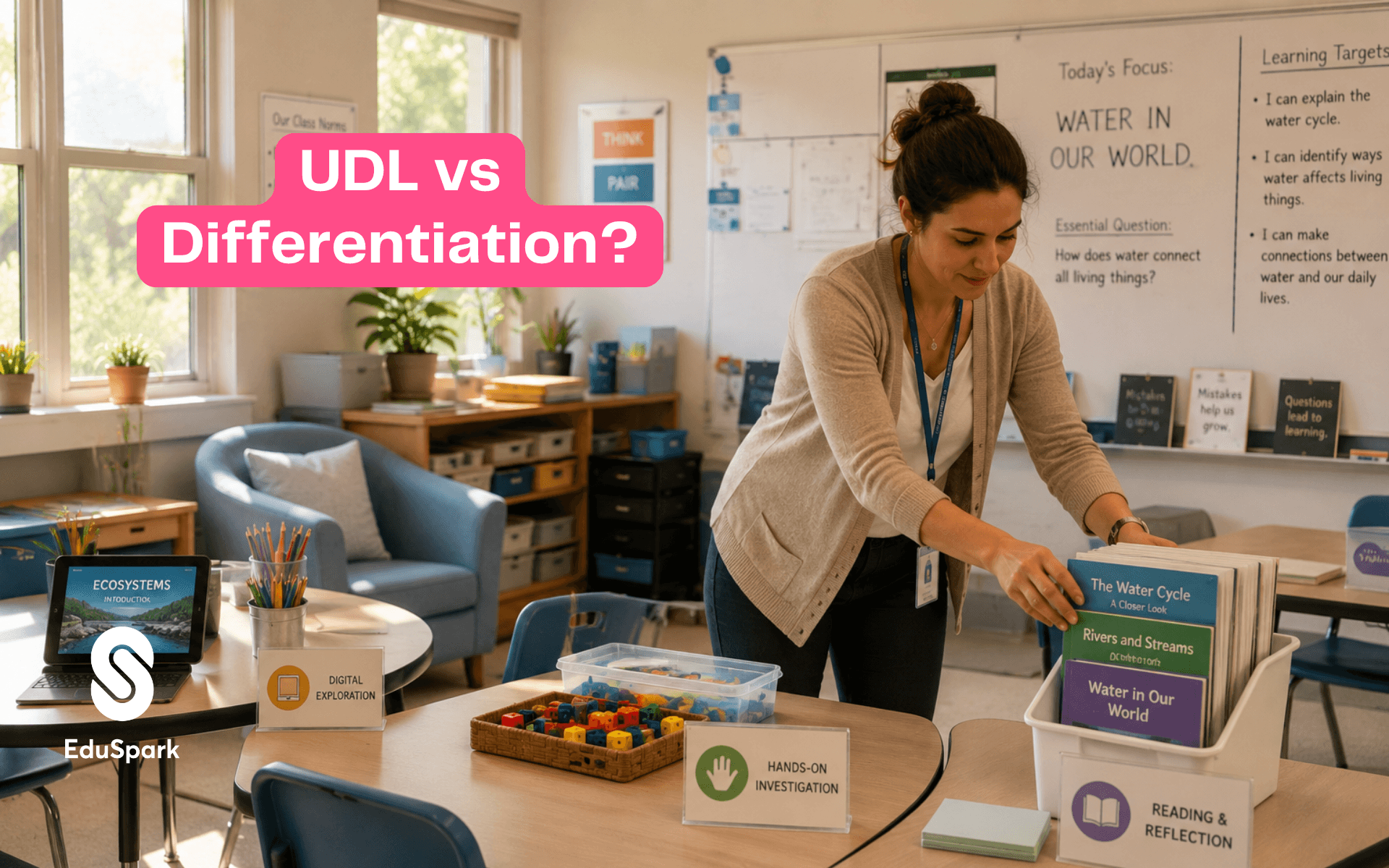
UDL vs Differentiation: What's the Difference (and How to Use Both)
Quick answer
Universal Design for Learning (UDL) and differentiation are related but distinct. UDL is a proactive framework: you design one lesson with built-in flexibility so it works for the full range of learners from the start. Differentiation is responsive: you adjust content, process or product for specific students once you know their needs.
Key facts
UDL was developed by CAST around three principles: multiple means of engagement, representation, and action/expression.
The core distinction is timing: UDL is designed in before the lesson happens; differentiation is applied in response to how students are actually doing.
Most guidance treats them as complementary, with UDL reducing the volume of individual differentiation a teacher needs to do reactively.
UDL: designed in from the start
UDL treats variability among learners as the expectation, not the exception, building flexibility into a lesson's goals, methods, materials and assessment before a single student walks in.
Differentiation: adjusted in response
Differentiation starts from what you observe about specific students and adjusts content, process, or product accordingly. This is the framework Carol Ann Tomlinson set out in The Differentiated Classroom: Responding to the Needs of All Learners (ASCD): matching what a student learns, how they learn it, and how they demonstrate it to that student's own readiness, interest and learning profile.
Where to start
Introduction to UDL (free) is taught by Katie Novak, Ed.D.: https://eduspark.world/courses/udl-now-introduction-to-udl-course
UDL and Differentiation: Practical Ideas and Strategies (Pro) is led by Tania Lattanzio and Dr. Jennifer Chang Wathall: https://eduspark.world/courses/UDL-differentiation-practical-ideas-and-strategies
Sources
- CAST, Universal Design for Learning framework: udlguidelines.cast.org
- Carol Ann Tomlinson, The Differentiated Classroom: Responding to the Needs of All Learners (ASCD)
- EduSpark course: Introduction to UDL (Katie Novak): eduspark.world/courses/udl-now-introduction-to-udl-course
- EduSpark course: UDL and Differentiation (Tania Lattanzio, Dr. Jennifer Chang Wathall): eduspark.world/courses/UDL-differentiation-practical-ideas-and-strategies
Start with UDL as a framework, not a slogan. Try Introduction to UDL free: https://eduspark.world/courses/udl-now-introduction-to-udl-course